
Developmental Milestones in Baby’s First Year
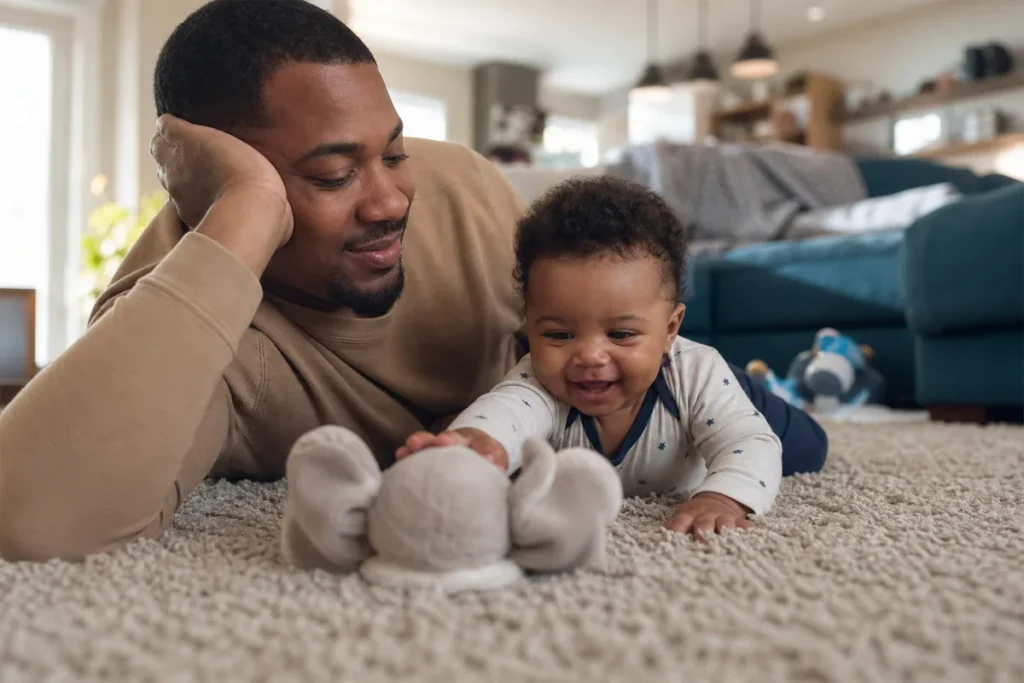
Every baby grows on a personal timeline, and healthy development spans a wide range rather than a single fixed schedule. Even so, the first twelve months tend to follow a broad arc that pediatricians recognize.
Knowing the usual pattern helps parents celebrate progress without turning normal variation into worry. The age clusters below describe what many babies do, along with signs worth raising with a pediatrician.
How milestones actually work
Milestones fall into four areas: motor skills such as rolling and grasping, language such as cooing and babbling, thinking skills such as finding a hidden toy, and social-emotional skills such as smiling and showing caution around strangers.
Babies rarely advance in every area at the same pace. A child who moves early may talk a little later, and both patterns can be completely typical.
Pediatric guidance describes milestones as what most children can do by a given age, not a pass-or-fail test. The real value lies in tracking the overall direction of growth across months rather than any single week.
Birth to 3 months
Newborns spend these weeks organizing basic responses to a brand-new world. Much of what looks like simple fussing or stretching is the nervous system learning to regulate.
By around 2 months, many babies produce a first social smile, quiet down at a familiar voice, and briefly follow a face or object with their eyes. During tummy time, they begin lifting the head and holding it for a few seconds.
Cooing and soft vowel sounds often start in this window. Hands stay fisted much of the time, then gradually open as muscle tone matures.
4 to 6 months
This stretch brings a burst of physical control and social play. Babies grow more deliberate about reaching, grabbing, and bringing objects toward the mouth to explore them.
By about 4 months, many infants hold the head steady, push up on their forearms during tummy time, and babble with new sounds. Belly laughs and squeals often appear, and babies may turn toward voices.
Somewhere between 4 and 6 months, rolling from front to back frequently begins, and some babies start sitting with support. Reaching for a toy with one or both hands is common by the end of this period.
7 to 9 months
The middle of the first year is defined by mobility and a growing sense of self. Babies often start moving across the floor and reacting more strongly to the people they know best.
Around 6 to 9 months, many infants sit without support, pass a toy from one hand to the other, and begin some form of crawling, scooting, or rocking on hands and knees. Babbling may take on repeated syllables like ba-ba or da-da.
Stranger awareness and early separation anxiety often surface now. A baby who cries when a parent leaves the room is usually showing healthy attachment, not a setback.
10 to 12 months
As the first birthday approaches, babies pull toward standing and communicate with growing intent. Play becomes more interactive and full of imitation.
Between 9 and 12 months, many pull up to stand, cruise along furniture, and use a neat pincer grasp to pick up small bites of food. Waving, clapping, and pointing often emerge, along with simple back-and-forth games such as peekaboo.
A first true word may arrive near 12 months, though plenty of typically developing babies say little yet understand a great deal. Walking can start anywhere from about 9 to 18 months, so a child who is not walking at the first birthday is usually still well within the normal range.
When variation is normal
Ranges exist because babies are individuals. Temperament, birth history, time spent on the floor, and even birth order can shift the timing of a given skill.
Babies born several weeks early are often tracked by their adjusted age, which accounts for the early arrival. A pediatrician can explain how that adjustment applies to a specific child.
Short plateaus and even brief regressions around big transitions, such as learning to walk, happen in healthy development. The encouraging sign is steady forward movement over time, not a perfect week-by-week march.
When to talk to a pediatrician
Regular well-child visits are the best setting for milestone questions, since providers watch patterns across many months. Bringing a short list of observations makes those visits more useful.
Certain signs deserve a conversation sooner rather than later. Reach out if a baby is not making eye contact or smiling socially by around 3 months, is not babbling or reacting to sound, seems very stiff or very floppy, is not bearing any weight on the legs with support by about 7 months, or loses a skill that was already present.
Losing skills, in particular, always warrants a prompt call. Trusting parental instinct matters here; a parent who senses something is off should ask, because early support tends to work best when it starts early.
If a concern comes up, the pediatrician may suggest continued monitoring or a developmental evaluation. Families in Oklahoma can also request a free evaluation through SoonerStart early intervention, and children’s coverage questions can be explored through SoonerCare.
Frequently asked questions
Is it a problem if my baby skips crawling?
Not usually. Some healthy babies scoot, roll, or bottom-shuffle instead of crawling, and a few move straight to pulling up and cruising. Mention it at the next visit so the pediatrician can confirm that other motor skills are on track.
My baby isn’t talking at 12 months. Should I worry?
Many babies say their first clear word around the first birthday, but the range is wide. Babbling, pointing, and understanding simple requests are strong signs of language growth even before words arrive. Raise it with your pediatrician if there is little babbling or no response to familiar sounds.
How much does premature birth affect milestones?
Babies born early are often measured by adjusted age, which subtracts the weeks of prematurity. A baby born two months early may reach milestones closer to that adjusted timeline. Your pediatrician can explain how long to apply the adjustment.
What is the single most important warning sign?
Losing a skill a baby already had, such as no longer babbling or no longer making eye contact, deserves a prompt call to the pediatrician. Regression is treated more seriously than a milestone that is simply taking longer to appear.
Do milestone checklists replace doctor visits?
No. Checklists are helpful for noticing patterns and organizing questions, but they cannot examine a child. Well-child visits pair those observations with a physical exam and professional judgment.
Where to go next
As babies grow into toddlers, language often takes center stage; the guide to toddler speech development covers the next stage in detail, and the overview of the preschool years looks further ahead. Oklahoma families with milestone questions can request a free evaluation through SoonerStart or review children’s coverage options through SoonerCare.